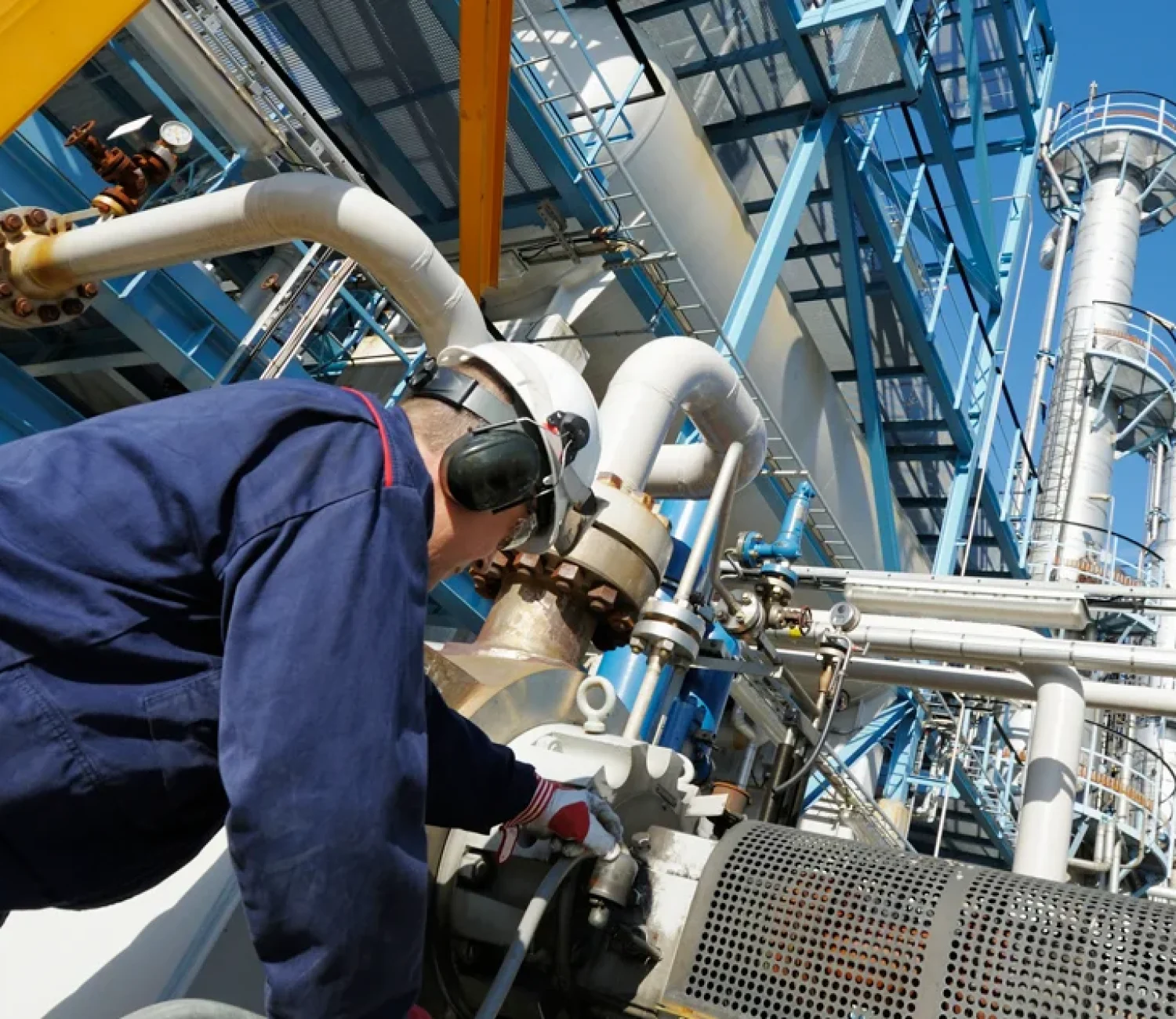


Industrial maintenance is no longer just a technical function within a plant. It is a key strategy for ensuring operational continuity, safety, and competitiveness.
Many companies remain stuck in the cycle of unplanned corrective maintenance—that is, “putting out fires” when a machine breaks down. But this ultimately leads to stoppages and downtime, complex and costly repairs, and, ultimately, a direct impact on productivity.
But what exactly is industrial maintenance? What types are there? How can you design a machinery maintenance plan that prevents plant downtime without driving up costs?
In this basic guide, we cover the key concepts of industrial maintenance and how a well-designed strategy can prevent unplanned downtime and improve plant profitability.
The “Snowball Effect” in Industrial Maintenance
One of the most illustrative concepts in industrial asset management is the so-called “snowball” effect”. Describe how a a seemingly minor deviation may end up causing a serious malfunction if it is not detected and corrected in time.
Let's imagine a common situation on the production floor: a lack of lubrication in a bearing. Resolving this problem early on involves a simple, low-cost intervention in terms of both materials and technician time.
However, when that anomaly is neither identified nor corrected, the situation gradually changes.
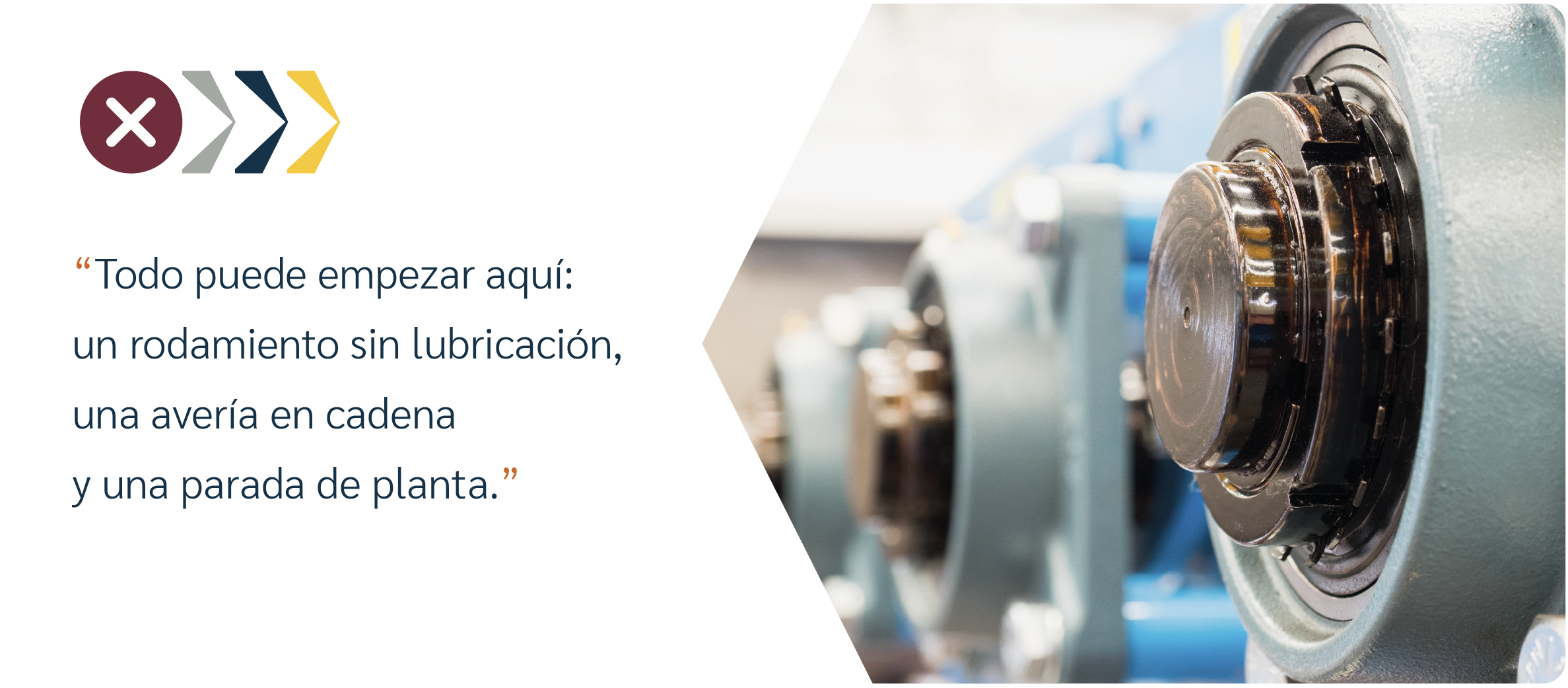
The bearing begins to wear out. This wear causes a slight misalignment in the shaft. The misalignment causes additional vibrations. The vibrations increase the dynamic load on the assembly. And that overload ultimately affects the motor.
What starts out as a minor issue can end up turning into a major repair, with much higher costs and, most critically, an unplanned shutdown.
Let's look at a very clear example: a lack of lubrication can eventually destroy a bearing, which will cause a shaft to become misaligned and ultimately lead to the failure of an entire motor.
This effect is not unusual. It is commonly found in pumps, gearboxes, conveyor belts, pneumatic systems, and rotating assemblies. In many cases, a small deviation, a worn gasket, or a damaged seal can trigger a chain reaction of failures. For example, sealing components—such as rotary seals and O-rings—are critical for preventing leaks, lubricant loss, or contamination. When these components fail, the deterioration isn’t always immediate, but it is progressive. And if left unchecked, it triggers that cumulative effect characteristic of a snowball.
This is where the industrial maintenance plan must be judicious: it must detect deviations in their early stages and prevent that chain of deterioration from progressing.
Because in maintenance, the problem is rarely the first symptom. The real risk lies in what happens next.
The 3 Types of Industrial Maintenance: Preventive, Corrective, and Predictive
To develop a solid strategy, it is essential to understand the three main types of industrial maintenance.
Preventive maintenance: taking action before a failure occurs

Preventive maintenance is based on acting according to time or usage intervals. Including actions such as periodic oil changes, scheduled filter replacements, alignment checks, and routine inspections will help reduce the likelihood of failure by addressing potential issues proactively.
It is especially useful for critical equipment whose failure could seriously affect production.
However, preventive maintenance does not always detect emerging problems that arise between inspection cycles.
Corrective Maintenance: Reactive and Planned

Corrective maintenance occurs when a part fails and must be replaced.
It's important to understand one thing: not all corrective maintenance is negative; its impact depends on whether it is planned or unplanned.
When we talk about unplanned corrective maintenance (when a machine unexpectedly shuts down), we are inevitably talking about financial losses and operational risks.
However, a planned corrective action can be a valid strategy. For certain low-cost, low-criticality components, it may be more efficient to allow the part to reach the end of its useful life and replace it then, rather than taking action prematurely.
The key is always in control and planning, not in completely eliminating corrective action.
Predictive maintenance: acting based on actual conditions

Predictive maintenance is based on monitoring the condition of equipment.
Instead of following a schedule, techniques such as the following are used:
- Vibration sensors.
- Thermography.
- Condition Analysis.
- Monitoring of operational parameters.
Its goal is to detect anomalies before they turn into serious malfunctions.
Predictive maintenance allows you to take action at exactly the right time, but implementing it comes at a cost, and it is not always necessary to apply it to all assets.
There is no single industrial maintenance strategy
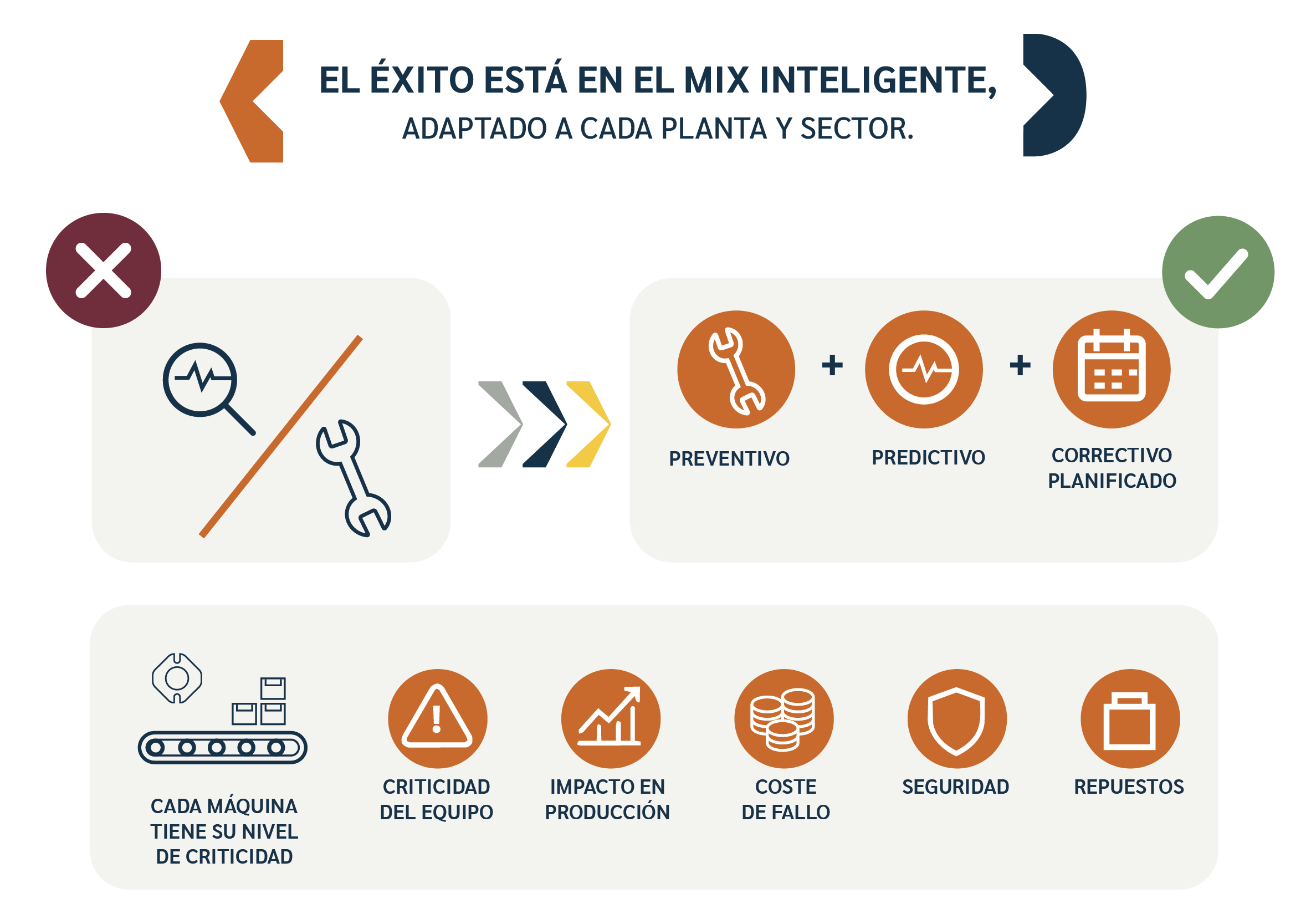
One of the most common mistakes is to think that the solution lies in relying exclusively on predictive maintenance or eliminating corrective maintenance entirely.
The reality is more complex.
An effective industrial maintenance plan combines:
- Preventive maintenance for strategic equipment.
- Predictive maintenance for critical assets.
- Planned correction for secondary components.
Each machine has a different level of criticality. A main production motor is not the same as a low-impact auxiliary component.
Industrial asset management should be based on:
- Equipment Criticality.
- Impact on production.
- Cost of failure.
- Safety.
- Availability of replacement parts.
The key is not to choose a single type of maintenance, but to know how to design a smart mix tailored to each plant and sector.
At ADALIS We take a comprehensive approach to industrial maintenance, combining technical expertise, the supply of critical components, and the design of strategies tailored to each production environment through our industrial maintenance service.
How to Prevent Plant Downtime Through a Smart Maintenance Strategy
Avoiding plant shutdowns does not mean eliminating the risk entirely, but rather managing it strategically.
A balanced approach allows for:
- Reduce unexpected failures.
- Extend the service life of the equipment.
- Improve worker safety.
- Maintain competitiveness in terms of delivery times.
From ADALIS Industrial Solutions We combine technical expertise, critical components, and solutions tailored to each production environment to anticipate failures and optimize maintenance.
Do you need a plan tailored to your assets to avoid unnecessary downtime?
Our team It can help you transform your plant from a reactive one into a more competitive one.
Because optimizing maintenance is an ongoing process, we will continue to delve deeper into each strategy and its technical application on the shop floor.