
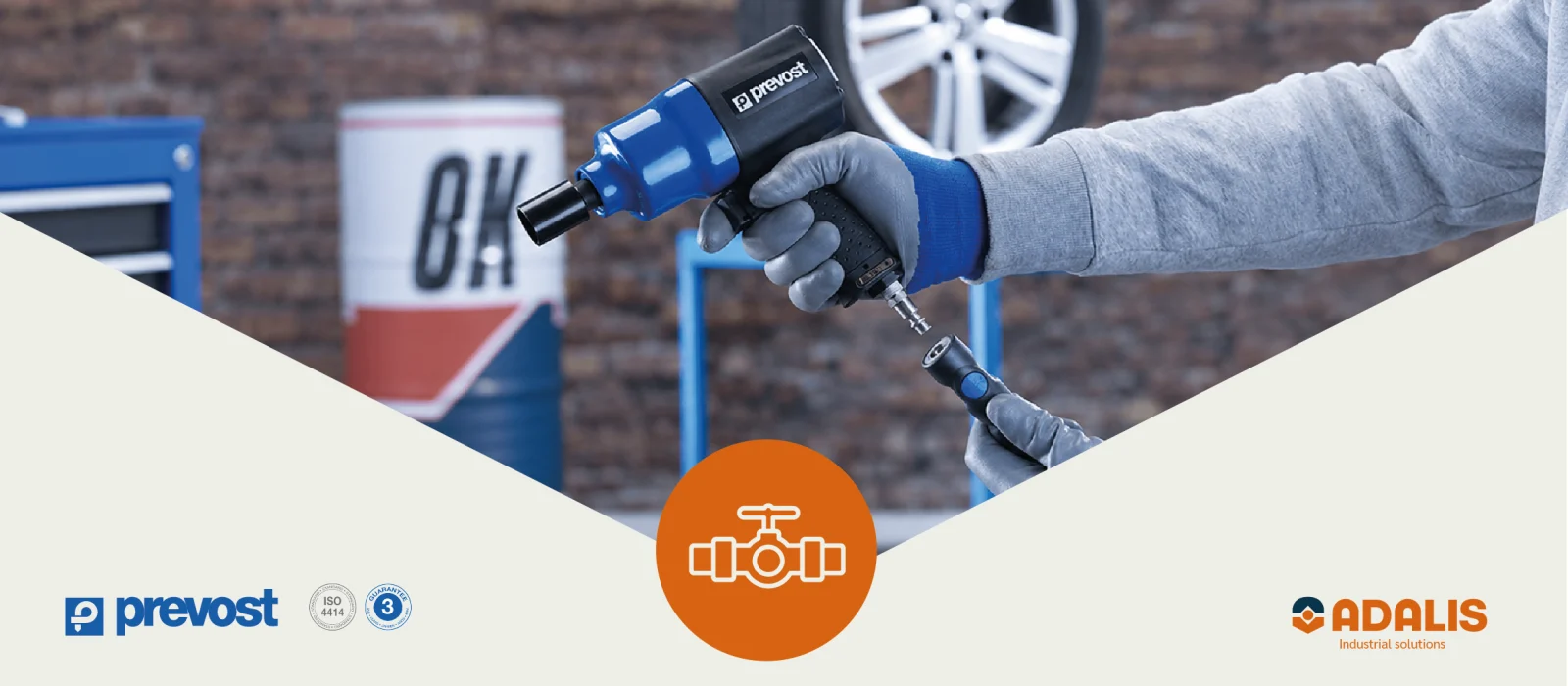
Disconnecting a pneumatic tool is an action that any operator repeats dozens of times a day. It’s so routine that almost no one thinks about what’s happening inside the hose at that moment. But if the connection comes loose while the line is still pressurized, the air rushes out suddenly and the hose can jerk violently. This is known as whiplash effect in compressed air.
This is a little-known but very real workplace hazard, and it remains a problem in many facilities because conventional connections are still in use. In this article, we explain why it occurs, what consequences it can have, and how to Prevost quick-connect safety couplers allow it to be removed through controlled decompression.
What Is the Whip Effect in Compressed Air?
When a conventional quick-connect coupling is disconnected, the section of hose that remains connected to the tool is still filled with pressurized air. When the connection is broken, that residual pressure is released abruptly, and the hose—with nothing to hold it in place—flips around in all directions.
The National Institute for Occupational Safety and Health (INSST) describes this phenomenon in its NTP 631 on Compressed-Air-Powered Equipment and Tools like a “A sudden, serpentine or whiplash-like movement caused by the abrupt release of compressed air, which can result in injury.”.
The risk increases with working pressure, diameter, and hose length: the more air that accumulates, the more energy is released when the connection is broken.
Risks of the whiplash effect in compressed air for operators and facilities
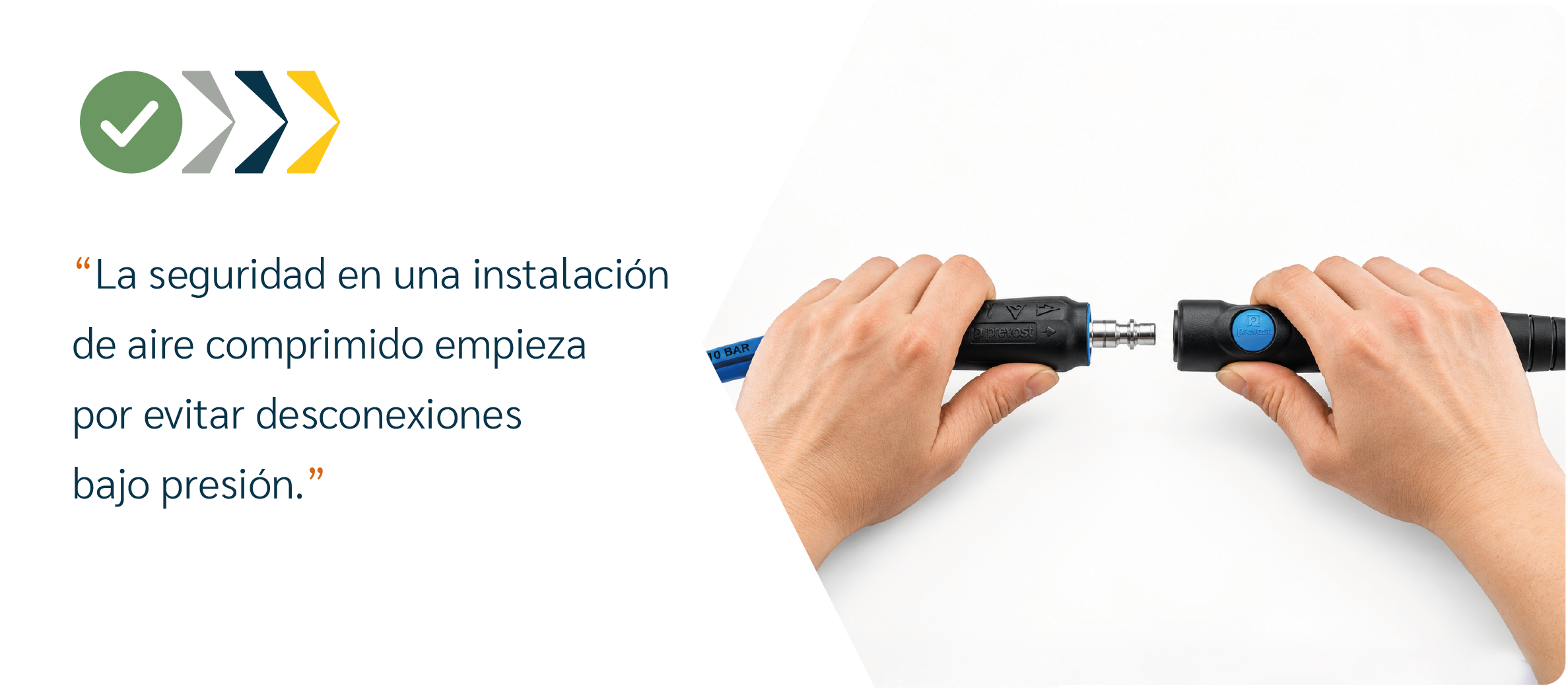
Many facilities still use connections that, when disconnected under pressure, can cause:
- Blows to the worker, especially to the hands, face, and eyes.
- Damage to nearby tools, products, and equipment.
- Accidental disconnections during work.
- Production stoppages and interruptions.
In addition to these consequences, there is the risk of failing to comply with occupational safety and health obligations. And in industries with high safety requirements—such as those operating in ATEX-classified areas with potentially explosive atmospheres—the safety of every component in the pneumatic system becomes a critical factor.
What Risk Prevention Recommendations Are There for Whiplash?
INSST Technical Note 631 itself is clear regarding the design requirements for hose couplings: they must be designed so that, when disconnected, the flow of compressed air is automatically shut off and the disconnected section is slowly depressurized.
In addition, the technical note states that when the hose has a diameter greater than 10 mm, a length greater than 10 meters, or operates at a pressure greater than 7 bar, The coupling must allow the section to be disconnected to be depressurized before disconnection occurs.
In other words: the solution isn't just about training the operator, but about installing connections that prevent whiplash by design. This measure should be supplemented with the personal protective equipment appropriate for each position.
Prevost Quick-Connect Safety Couplings to Prevent Whiplash
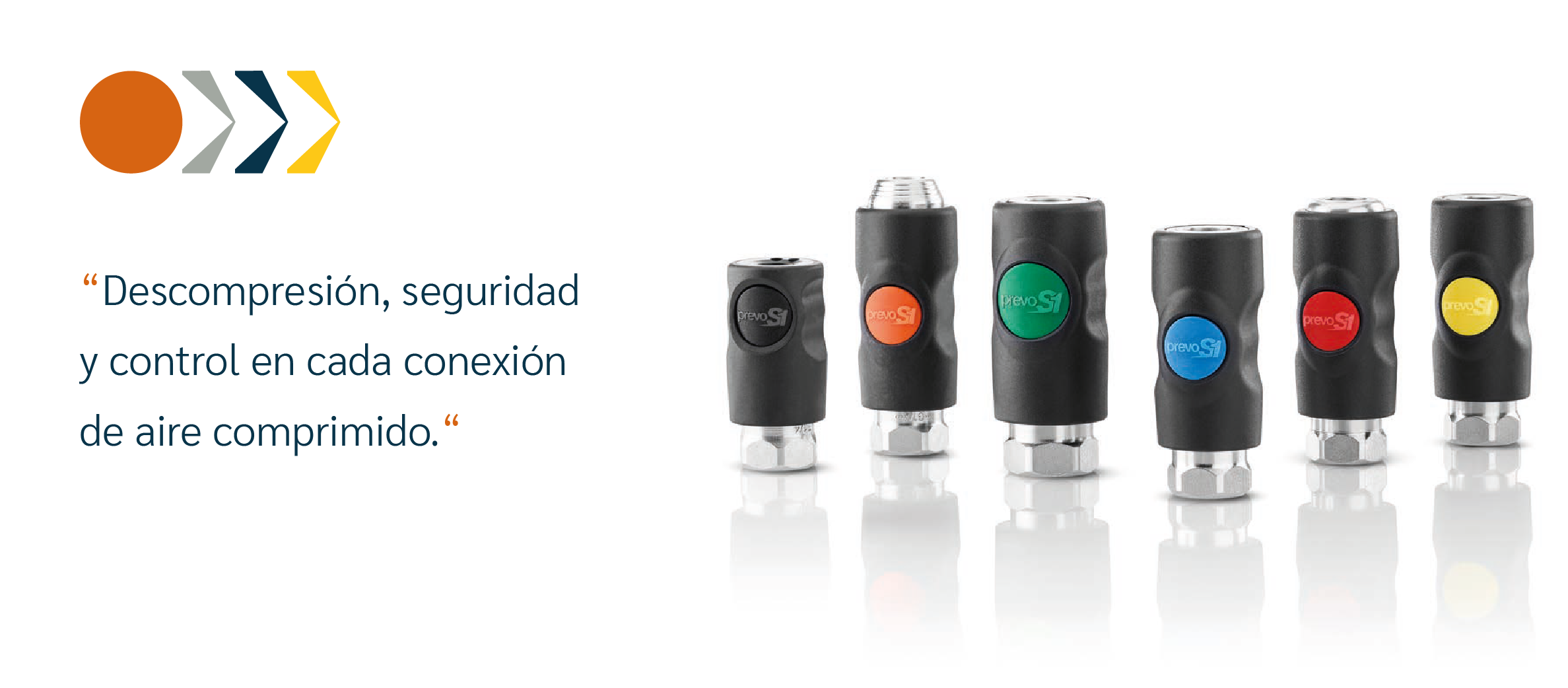
The prevoS1 Quick-Connect Safety Plugs They incorporate a pre-disconnection decompression system that eliminates residual pressure before the connection is completely severed. In this way, they meet risk prevention requirements and offer other safety benefits. They are part of the Prevost's line of quick-connect couplers, which includes solutions for compressed air, breathing air, water, and cooling fluids.
Controlled decompression to prevent the whiplash effect in compressed air
The prevoS1 It automatically manages pressure relief and disconnection. With a single motion, the operator relieves pressure and disconnects the tool without a sudden release of pressure. This eliminates the risk of recoil or accidental disconnection, as well as any danger to the operator, nearby products, or tools.
Color-coding to prevent connection errors
The plug button features a color-coding system that allows you to identify the international standard of each connection at a glance. This reduces errors when plugging in and minimizes the risk of damage caused by incompatibilities between plugs and outlets.
Antistatic construction
prevoS1 plugs prevent the buildup of static electricity. This provides a safety benefit in certain industrial applications and also improves quality in painting or varnishing processes, where static electricity attracts dust to surfaces.
Designed for ATEX zones and demanding environments
Prevost safety quick-connect couplers are designed for installations with high safety requirements:
- Compatible with ATEX Zones 1 and 2 (gas) and 21 and 22 (dust).
- Compliant with the European Pressure Equipment Directive.
- They meet the safety requirements of ISO 4414, which governs the safety of pneumatic systems.
- Compliant with the European RoHS Directive.
Safety in Your Compressed Air System with ADALIS
The whiplash effect in compressed air systems is a real but preventable risk. Replace conventional connections with quick-connect fittings and safety connectors It protects workers, reduces equipment damage, and helps ensure compliance with industrial safety requirements and applicable regulations.
At ADALIS, we'll help you review your compressed air system and identify the connection points where it is advisable to install Prevost safety quick-connect plugs.
Contact our technical team and we'll help you choose the right solution for each application.